- 11th August, 2026
- By Stuart
Heel Pain That Won't Settle? Why Different Achilles Tendinopathies Need Different Rehab

Achilles tendinopathy is one of the most common overuse injuries we see at Restore Physio. Interestingly, not all Achilles pain responds to the same rehab, and the wrong exercise (although well-meaning) might accidentally aggravate the injury further.
Here's what Achilles tendinopathy actually is, why location changes everything, what the latest research tells us, and how we approach it in the clinic.
What Is Achilles Tendinopathy?
Achilles tendinopathy is pain, stiffness and reduced strength in the Achilles tendon. This is the thick band connecting your calf muscles to your heel bone. We see this very commonly in runners and other sport-active people, and it's categorised into two types based on where the pain sits.
Insertional vs Mid-Portion Achilles Tendinopathy
Understanding this distinction is important because where your pain sits changes how it should be rehabilitated. Insertional and mid-portion Achilles tendinopathy are different conditions.
Why Generic Stretches and Heel Drops Can Backfire
For a long time, Achilles tendinopathy was treated as a pure tension problem. The tendon was thought to be "tight" or under-loaded, so deep stretching and heel drops made sense as treatment.
But doing this doesn't just stretch the tendon; it also compresses it against the heel bone as the tendon wraps around it. If the tendon is already thickened and irritated, this can exacerbate the condition and make it more inflamed.
This is exactly why a patient with insertional Achilles tendinopathy can follow generic "Achilles stretch" advice and end up worse off, and research shows this.
What the Research Shows: Reducing Tendon Compression Speeds Up Recovery
A randomised clinical trial published in the British Journal of Sports Medicine (2025) put this idea to the test in 42 sport-active adults with insertional Achilles tendinopathy.
Both groups followed the same progressive four-stage tendon-loading programme: isometric, isotonic, energy-storage and sport-specific exercises. The only difference is this: one group also limited ankle dorsiflexion during exercise, skipped calf stretching, and wore heel lifts to reduce compression at the tendon insertion throughout rehab.
The compression-limiting group showed higher progress at both 12 and 24 weeks, with meaningfully better pain and function scores, higher satisfaction, and a faster return to sport.
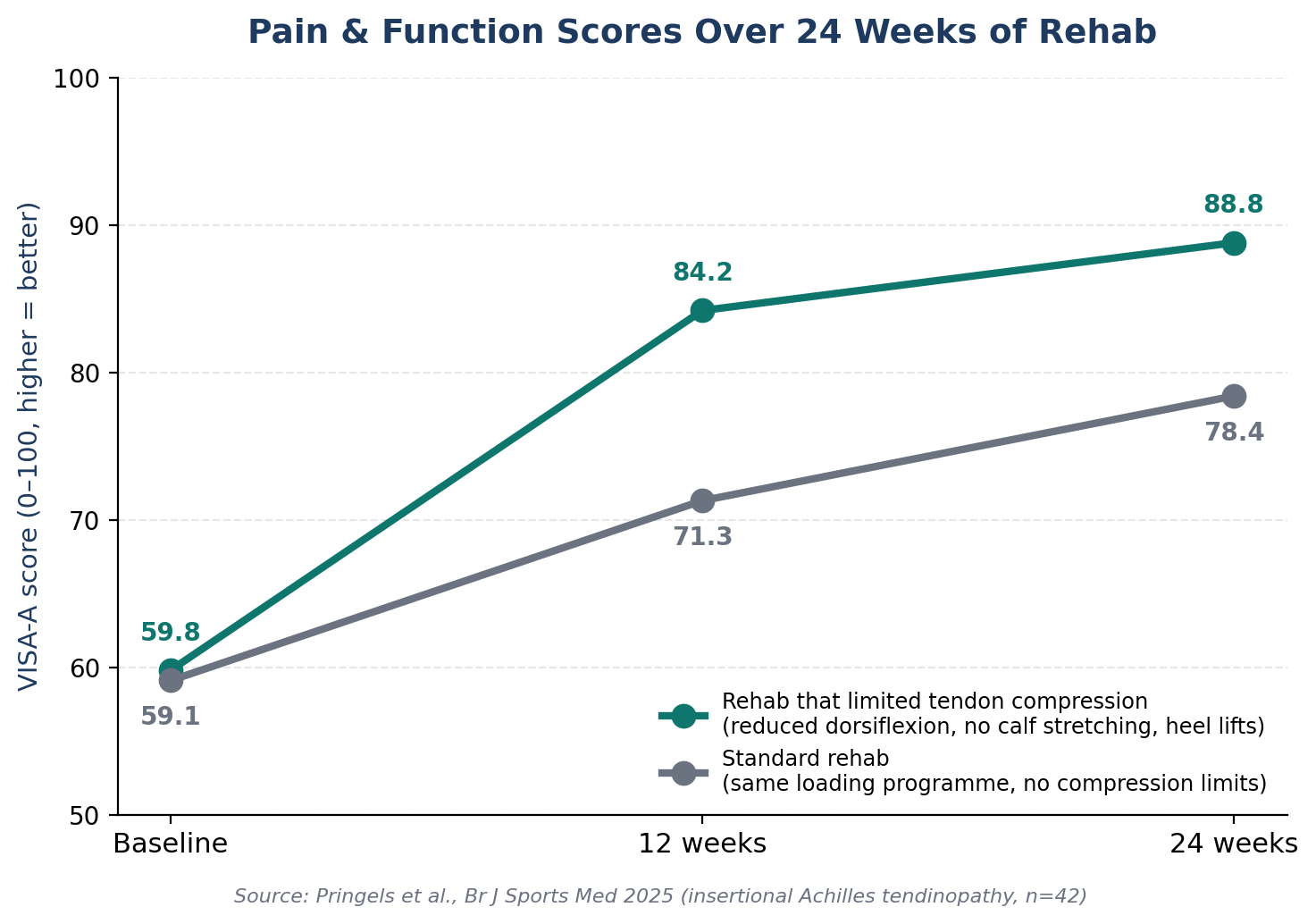
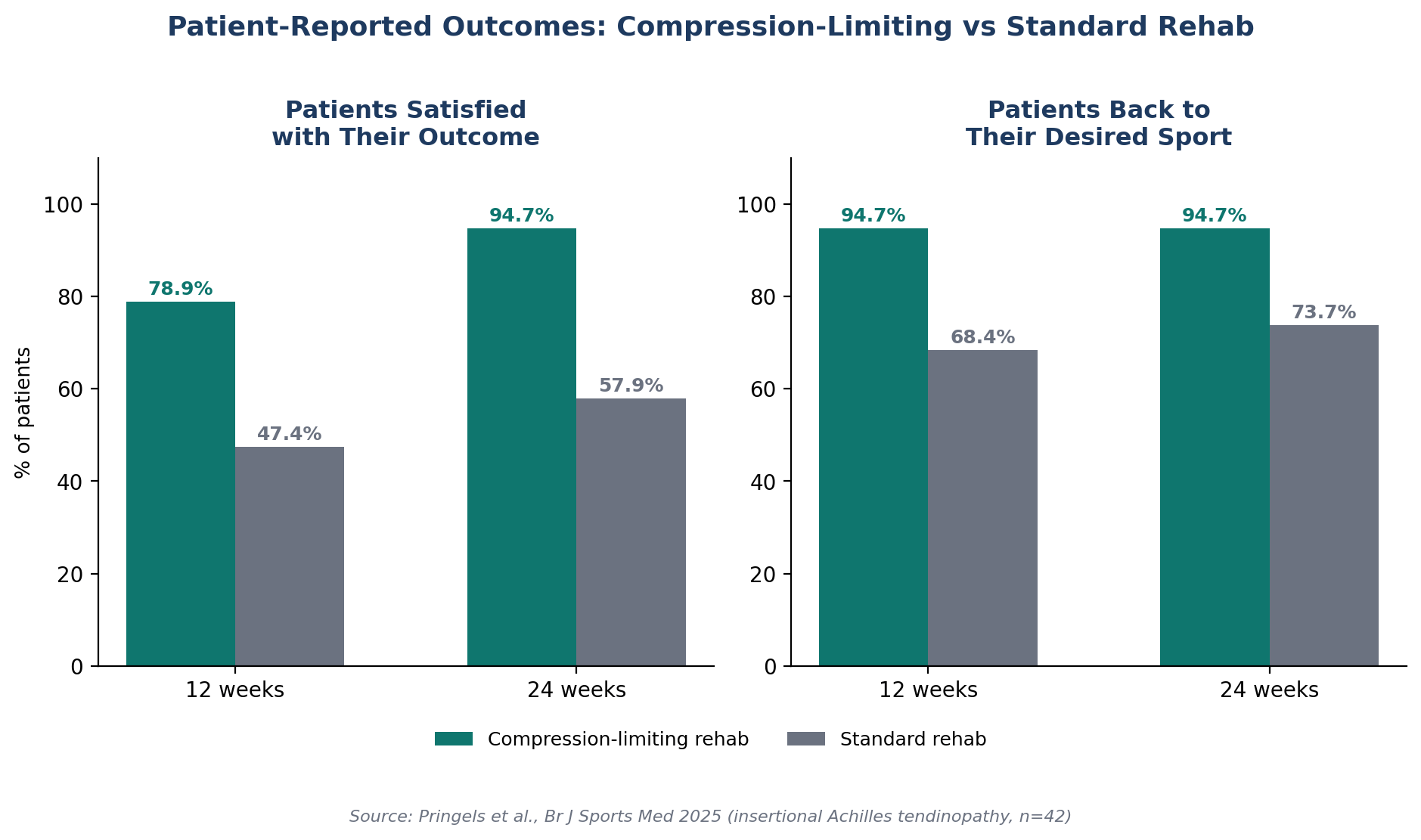
Both groups improved, but the group that limited tendon compression improved by a wider, clinically meaningful margin. By 24 weeks, almost 95% of the compression-limiting group were satisfied with their outcome and back to their sport, compared with under 75% of the standard rehab group.
So what does this tell us? Your Achilles tendinopathy rehab program has to be tailored to your unique condition and done by experienced professionals.
How We Rehab Achilles Tendinopathy at Restore Physio
This study reinforced an approach we already take at Restore: recognising that insertional and mid-portion Achilles tendinopathy need slightly different loading strategies.
In practice, that means avoiding excessive dorsiflexion early on (no heel drops off a step for insertional cases), performing calf raises on flat ground before progressing range, and gradually reintroducing compressive load only as symptoms and tendon capacity allow.
Our rehab program for Achilles tendinopathy typically follows a similar staged structure:
Do You Need Heel Lifts or New Shoes?
We don't routinely prescribe heel lifts in the clinic for Achilles tendinopathy, as they can reduce tensile and compressive load on the tendon and they don't address the underlying issue. What we do advise on is footwear: supportive shoes that avoid pushing the ankle into excessive dorsiflexion or exposing the tendon to extreme load.
How Long Does It Actually Take to See Results?
Achilles tendinopathy is a condition that takes time to resolve, but we usually see big improvements within 3 to 6 months. At Restore, we set that expectation early so people don't give up on a plan that's actually working.
Gradual loading is the key here, and we implement sport-specific exercises to keep patients engaged through a somewhat long process.
Red Flags: When to Get It Assessed Rather Than Self-Manage
Get an assessment if you're experiencing:
A sudden pop, or a sensation like being kicked in the back of the leg (possible Achilles rupture).
Inability to weight-bear after the injury.
Significant loss of plantarflexion strength, or being unable to perform a single-leg heel raise at all.
Rapidly increasing pain, swelling, redness or warmth, especially with fever (this could be a possible infection).
Severe pain at rest or overnight that doesn't behave like typical tendinopathy.
A history of significant trauma with concern for a fracture or other structural injury.
Early treatment gives you a better chance of recovery. The longer Achilles tendinopathy is left untreated, or managed with the wrong loading strategy, the more persistent it tends to become.
We advise not to push through the pain or rely on generic online advice. Getting an accurate diagnosis early lets us build the right loading plan from day one, modify what's aggravating it, and guide a safe return to sport.
Key Takeaway
Achilles tendinopathy isn't a one-size-fits-all injury. Where your pain sits (i.e. insertional or mid-portion) changes how it should be loaded, and getting the right assessment helps you recover faster and get back to life as usual.
If your Achilles pain has been troubling you, book an assessment with Restore Physio, or learn more about our Achilles tendinopathy treatment.